Building a Bulletproof Prompt Injection Detector using SetFit with Just 32 Examples

In my previous post we built Prompt Injection Detector by training a LogisticRegression classifier on embeddings of SPML Chatbot Prompt Injection Dataset. Today, we will look at how we can fine-tune an embedding model and then use LogisticRegression classifier. I learnt this technique from Chatper 11 of Hands-On Large Language Models book. I am enjoying this book. It is practical take on LLMs and teaches you many practical and useful techniques that can one can apply in their work.

We can fine-tune an embedding on the complete dataset or few examples. In this post we will look at fine tuning for few shot classification. This technique shines when you have only a dozen or so examples in your dataset.

I fine-tuned the model on RunPod https://www.runpod.io/. It costed me 36 cents to fine tune and evaluate the model. I used 1 x RTX A5000 machine that has 16 vCPU and 62 GB RAM.

Continue reading “Building a Bulletproof Prompt Injection Detector using SetFit with Just 32 Examples”

A look at Patchwork: YC backed LLM Startup

In the last couple of days, I’ve spent some hours playing with Patchwork. Patchwork is an open-source framework that leverages AI to accelerate asynchronous development tasks like code reviews, linting, patching, and documentation. It is a Y Combinator backed company.

The GitHub repository for Patchwork can be found here: https://github.com/patched-codes/patchwork.

Patchwork offers two ways to use it. One is through their open-source CLI that utilizes LLMs like OpenAI to perform tasks. You can install the CLI using the following command:

pip install 'patchwork-cli[all]' --upgrade

The other option is to use their cloud offering at https://app.patched.codes/signin. There, you can either leverage predefined workflows or create your own using a visual editor.

This post focuses on my experience with their CLI tool, as I haven’t used their cloud offering yet.

Patchwork comes bundled with six patchflows:

  • GenerateDocstring: Generates docstrings for methods in your code.
  • AutoFix: Generates and applies fixes to code vulnerabilities within a repository.
  • PRReview: Upon PR creation, extracts code diffs, summarizes changes, and comments on the PR.
  • GenerateREADME: Creates a README markdown file for a given folder to add documentation to your repository.
  • DependencyUpgrade: Updates your dependencies from vulnerable versions to fixed ones.
  • ResolveIssue: Identifies the files in your repository that need updates to resolve an issue (or bug) and creates a PR to fix it.

A patchflow is composed of multiple steps. These steps are python code.

To understand how Patchwork works, we’ll explore a couple of predefined Patchflows.

Continue reading “A look at Patchwork: YC backed LLM Startup”

Meeting Long-Tail User Needs with LLMs

Today I was watching a talk by Maggie Appleton from local-first conference. She points out in her insightful talk on homecooked software and barefoot developers, there exists a significant gap in addressing long-tail user needs—those specific requirements of a small group that big tech companies often overlook. This disconnect stems primarily from the industrial software approach, which prioritizes scalability and profitability over the nuanced, localized solutions that users truly require.

The limitations of existing software from big tech companies become evident when we analyze their inability to address the long-tail of user needs. FAANG companies focus on creating solutions that appeal to the mass market, often sidelining niche requirements. For example, Google Maps can efficiently direct users from one location to another, but it fails to offer features like tracking historical site boundaries that may be crucial for a historian or a local community leader.

Continue reading “Meeting Long-Tail User Needs with LLMs”

Putting Constrained-CoT Prompting Technique to the Test: A Real-World Experiment

I was reading Concise Thoughts: Impact of Output Length on LLM Reasoning and Cost paper today and thought of applying it to a problem I solved a couple of months back. This paper introduced the Constrained Chain of Thought (CCoT) prompting technique as an optimization over Chain of Thought Prompting.

Chain of Thought prompting is a technique that encourages LLMs to generate responses by breaking down complex problems into smaller, sequential steps. This technique enhances reasoning and improves the model’s ability to arrive at accurate conclusions by explicitly outlining the thought process involved in solving a problem or answering a question.

When using Zero-shot CoT technique, adding the line “Let’s think a bit step by step” to the prompt encourages the model to first generate reasoning thoughts and then come up with an answer. In Zero-shot CCoT, the prompt is changed to limit the number of words, such as “Let’s think a bit step by step and limit to N words.” Here, N can be any suitable number for your problem.

The paper showed results with N being 15, 30, 45, 60, and 100. CCoT was equal or better than CoT for N 60 and 100. As mentioned in the paper, CCoT technique works with large models but not with smaller ones. If CCoT works as written in the paper, it leads to improved latency, less token usage, more coherent responses, and reduced cost.

One of the interesting LLM use cases I solved lately was building RAG over table data. In that project, we did extensive pre-processing of the documents at the ingestion time so that during inference/query time, we first find the right table in the right format and then answer the query using a well-crafted prompt and tools usage.

In this post, I will show you how to do Question Answering over a single table without any pre-processing. We will take a screenshot of the table and then use OpenAI’s vision model (gpt-4o and gpt-4o-mini) to generate answers using three prompting techniques: plain prompting, CoT (Chain of Thought) prompting, and CCoT (Constrained Chain of Thought) prompting.

Continue reading “Putting Constrained-CoT Prompting Technique to the Test: A Real-World Experiment”

Making sense of screenshots with CLIP model embeddings

Today I was reading Chapter 9 “Multimodal Large Language Models” of Hands-On Large Language Models book and thought of applying it to a problem I face occassionally. The chapter covers CLIP model and how you can use them to embed both text and images in the same vector space.

Like most normal humans, I take a lot of screenshots, and if I don’t categorize them at the time I took the screenshot, then there’s a lot of manual effort required to find them when I need them. So, I decided to build a quick semantic search on it using the llm utility.

Continue reading “Making sense of screenshots with CLIP model embeddings”

Oreilly Answers: A case study of poorly designed LLM powered RAG system

I enjoy reading books on Oreilly learning platform https://learning.oreilly.com/ . For the past month, a new feature on the Oreilly platform called “Answers” has been staring me down, and I haven’t been tempted to click it. Maybe it’s LLM fatigue, or something else I just didn’t give it a try. I do use LLM tools daily but most of these tools I have designed for myself around my workflows.

Today, I decided to give it a try. If you go to a book page like the one I am reading currently https://learning.oreilly.com/library/view/hands-on-large-language/9781098150952/ you will see Answers icon in the right side bar.

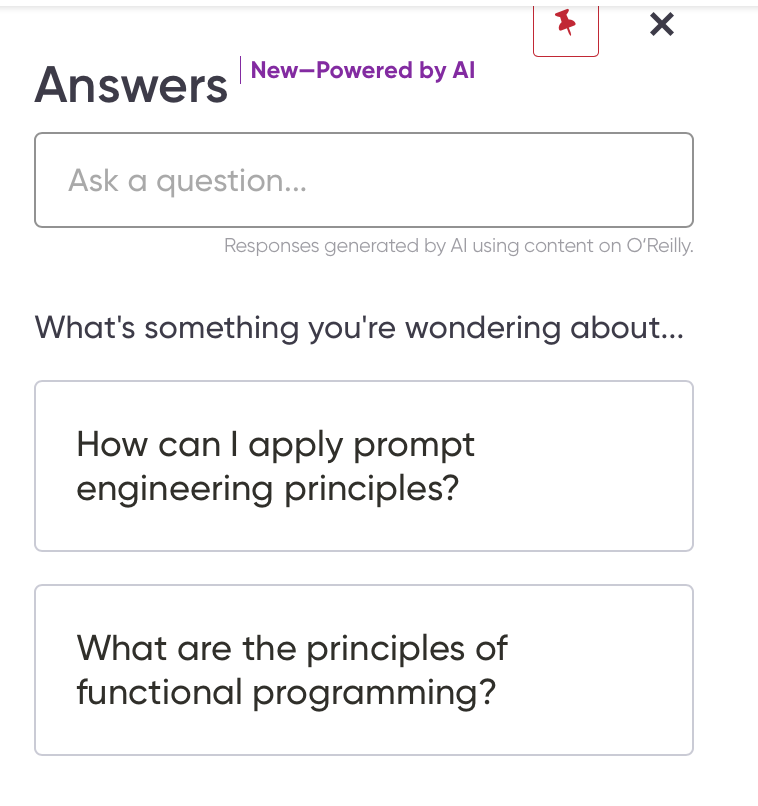
When you click on Answers it will show a standard Chat input box and suggestions. We all have seen them million times by now.

It looks like a standard Retrieval Augmented Generation (RAG) use case. When you ask a question it will search in its knowledge base(some sort of Vector/Hybrid search) and then generate the answer.

Continue reading “Oreilly Answers: A case study of poorly designed LLM powered RAG system”

Generating architecture.md with code2prompt and OpenAI gpt-4o-mini model

New contributors often struggle to grasp project intricacies without a well-defined architectural understanding documentation. This post exposes how we can leverage the power of Large Language Models (LLMs) to automate the generation of architecture documentation (architecture.md) directly from a project’s codebase. I first learnt about architecture.md from a post that was published in 2021. Many popular open source projects like Caddy have architecture.md in their source code.

We call our script as shown below.

./architecturemd-generator.sh https://github.com/frdel/agent-zero.git

and it generates architecture.md as shown below in the screenshot. You can look at the complete generated architecture.md file in the GitHub repository.

Continue reading “Generating architecture.md with code2prompt and OpenAI gpt-4o-mini model”

Building a YouTube Video Summarizer with llm and yt-dlp

In this blog post, we’ll create a handy utility that summarizes YouTube videos using the power of large language models (LLMs) and the versatility of Python’s yt-dlp tool. It leverages the summarizing capabilities of llm to extract key points and insights from YouTube subtitles, making it easier to grasp the video’s content without having to watch the entire thing.

Setting the Stage

Before we dive in, let’s ensure you have the necessary tools:

  1. llm: This command-line interface allows us to interact with large language models. Follow the installation instructions on the llm project’s website https://llm.datasette.io/en/stable/index.html.
  2. yt-dlp: This versatile tool helps download various formats from YouTube, including subtitles. Install it using pip install yt-dlp.
  3. Set OPENAI_API_KEY environment variables. This utility defaults to using OpenAI API and gpt-4o-mini model.

GitHub Repo

You can get the complete source code here https://github.com/shekhargulati/llm-tools.

Continue reading “Building a YouTube Video Summarizer with llm and yt-dlp”

Building Prompt Injection Detector with Text Embeddings and LogisticRegression

In this post, we will discuss how to build a Prompt Injection detector using a simple classification task with Scikit-learn’s Logistic Regression. Logistic Regression is a statistical method for binary classification problems. It helps predict situations with only two possible outcomes.

We will use SPML Chatbot Prompt Injection Dataset for input data.

Install the following libraries:

pip install datasets
pip install sentence-transformers
pip install scikit-learn

We will start by loading the dataset

from datasets import load_dataset
dataset = load_dataset("reshabhs/SPML_Chatbot_Prompt_Injection")

Let’s look at the dataset

dataset
DatasetDict({
    train: Dataset({
        features: ['System Prompt', 'User Prompt', 'Prompt injection', 'Degree', 'Source'],
        num_rows: 16012
    })
})

This displays the dataset structure. There are 16,012 records in this dataset, each with five columns:

  • System Prompt
  • User Prompt
  • Prompt injection
  • Degree
  • Source
Continue reading “Building Prompt Injection Detector with Text Embeddings and LogisticRegression”

Leveraging BERTopic to Understand AI Assistant Usage Patterns

I am building and operating a ChatGPT like enteprise AI-Assistant for a year. We log all the user queries in a database for future analysis and building personalized features. We have seen its usage grow over time and it is becoming difficult for our small team(4) to use manual quality analysis methods like eye balling and vibe checks to understand system accuracy and usage patterns.

In this quick post I will cover how we can use BERTopic and OpenAI gpt-4o-mini model to cluster user queries into labelled groups. We will run this analysis on Chatbot Arena dataset.

This dataset contains 33K cleaned conversations with pairwise human preferences. It is collected from 13K unique IP addresses on the Chatbot Arena from April to June 2023. Each sample includes a question ID, two model names, their full conversation text in OpenAI API JSON format, the user vote, the anonymized user ID, the detected language tag, the OpenAI moderation API tag, the additional toxic tag, and the timestamp.

BERTopic is an open-source project offers a novel approach to topic modelling. Topic modelling is an unsupervised and exploratory approach to make sense of bunch of documents.

BERTopic leveraging the power of BERT, a state-of-the-art language model, and c-TF-IDF ( a variation of the traditional TF-IDF (Term Frequency-Inverse Document Frequency) algorithm designed to work with multiple classes or clusters of documents), BERTopic helps uncover hidden thematic structures within your text data. This approach assumes that documents grouped by semantic similarity can effectively represent a topic, where each cluster reflects a major theme and the combined clusters paint a broader picture.

Continue reading “Leveraging BERTopic to Understand AI Assistant Usage Patterns”