Setting a realistic accuracy target for LLM tasks

Today I was reading OpenAI guide on model selection https://platform.openai.com/docs/guides/model-selection where they explained how to calculate a reaslistic accuracy target for LLM task by evaluating financial impact of model decisions. They gave an example of fake news classifier.

In a fake news classification scenario:

  • Correctly classified news: If the model classifies it correctly, it saves you the cost of a human reviewing it – let’s assume $50.
  • Incorrectly classified news: If it falsely classifies a safe article or misses a fake news article, it may trigger a review process and possible complaint, which might cost us $300.

Our news classification example would need 85.8% accuracy to cover costs, so targeting 90% or more ensures an overall return on investment. Use these calculations to set an effective accuracy target based on your specific cost structures.

This is a good way to find the accuracy you need for the task. Break-even accuracy is calculated using the below formula

Break-even Accuracy = Cost of Wrong ÷ (Cost of Wrong + Cost Savings)

Below break-even you lose money. At break-even you break even. Above break-even you make profit. The target accuracy ensures your desired ROI. I have built a simple calculator that you can use https://tools.o14.ai/llm-task-accuracy-calculator.html.
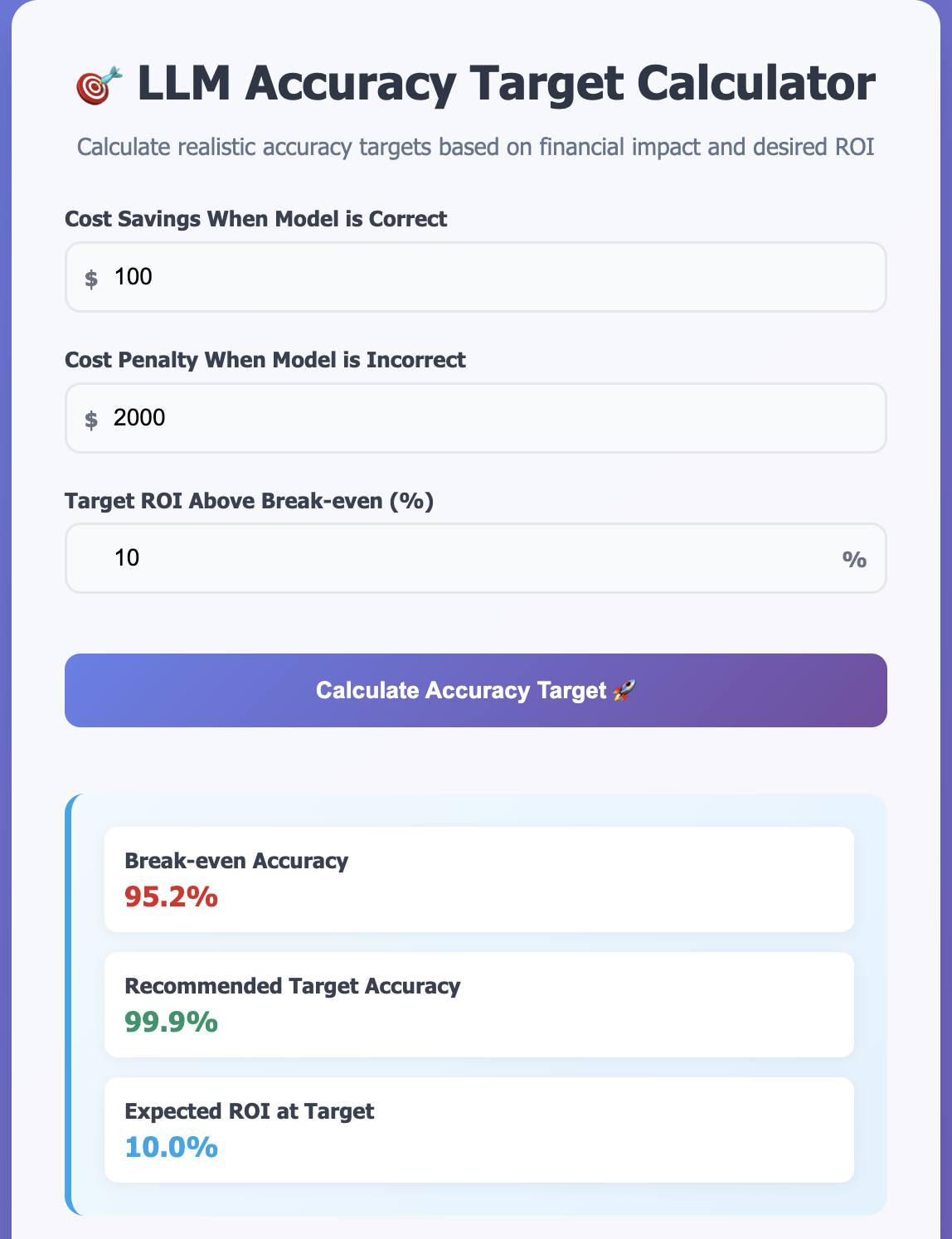
This calculation works well when you are making binary decisions with LLMs. These are usually classification tasks. Below are some examples.

Content Moderation

  • Correct: Properly moderate content → Save $20 in manual review
  • Incorrect: Miss harmful content or over-moderate → $500 in legal/PR costs

Resume Screening

  • Correct: Identify good candidate → Save $100 in recruiter time
  • Incorrect: Miss good candidate or pass bad one → $2,000 in hiring costs

Code Review Automation

  • Correct: Catch bug before production → Save $200 in developer time
  • Incorrect: Miss critical bug → $10,000 in downtime costs

You can also adapt it to other domains like customer service chatbots. Instead of correct/incorrect, use quality tiers:

  • High quality response: Save $25 (avoid human agent)
  • Medium quality: $10 cost (requires follow-up)
  • Poor quality: $75 cost (frustrated customer + human intervention)

Any LLM task with measurable business impact can use cost-benefit analysis – you just need to define what “quality” means for your specific use case and map it to financial outcomes.

Changes in Cursor Pricing

Cursor, the AI-powered code editor that has transformed how developers write code, recently underwent a significant pricing overhaul that has sparked intense debate in the developer community. The changes reveal a fundamental challenge facing AI coding tools: how to fairly price services when underlying costs vary dramatically based on usage patterns.

The Old Pricing Model

Previously, Cursor’s $20 per month Pro plan operated on a straightforward request-based system. Users received 500 requests monthly, with Claude Sonnet 4 consuming two request units due to its higher computational demands, while other models like GPT-4.1 and Gemini consumed just one unit each. This meant Pro users could make approximately 250 Claude Sonnet 4 requests per month.

While this pricing model was transparent and predictable, it failed to account for the reality of modern AI systems where token consumption varies wildly between requests. A simple code completion might use 100 tokens, while a complex refactoring task could consume 50,000+ tokens—yet both counted as a single “request” under the old system.

The New Pricing Model

On June 16, 2025, Cursor introduced a new pricing model that reflects actual API costs. The Pro plan now includes $20 of frontier model usage per month at API pricing, with an option to purchase additional usage at cost. For users who prefer unlimited usage, Cursor offers an “Auto” mode that automatically routes requests to different frontier models based on capacity.

As Cursor explained in their blog post: “New models can spend more tokens per request on longer-horizon tasks. Though most users’ costs have stayed fairly constant, the hardest requests cost an order of magnitude more than simple ones. API-based pricing is the best way to reflect that.”

Based on current API pricing, the $20 credit covers approximately 225 Claude Sonnet 4 requests, 550 Gemini requests, or 650 GPT-4.1 requests under typical usage patterns. However, with coding agents and complex context passing, actual costs can be significantly higher.

The Broader Lesson: Token Economics Matter

Cursor’s pricing evolution illustrates a critical principle for LLM-based products: token consumption patterns must drive pricing strategies. Input tokens often cost more than output tokens in real-world scenarios, making efficient context engineering essential for cost control.

For developers building products in the LLM landscape, this shift serves as a reminder that sustainable pricing requires understanding and reflecting actual usage costs. The days of flat-rate “unlimited” AI services may be numbered as providers grapple with the economic realities of rapidly advancing—and increasingly expensive—AI models.

Cost Calculator

You can explore the cost implications using our interactive Cursor pricing calculator to see how the pricing changes affect different usage patterns.

As you can see in the screenshot above, the old pricing model did not account for tokens, making it significantly cheaper than the new plan. When you’re using coding agents and passing in context, you often end up hitting token usage levels similar to what I’ve shown.